Last Updated: November 4, 2026
Quick Summary
The best high performance optics for home defense are red dot and holographic sights, because they let you place a single aiming point on the target with both eyes open. For indoor use, a 1x setting on a low-power variable optic or prism sight is a strong choice, since it keeps the field of view wide while offering magnification when needed.
- Optics reduce aiming to one dot or reticle, keeping both eyes open and head position consistent.
- Holographic sights generally tolerate an off-center eye position better than red dots.
- Red dots generally run longer on a single battery than holographic sights.
- Test the optic at the dimmest and brightest light levels in your home before relying on it.
- Keep magnification at 1x indoors, since higher power enlarges sight-picture wobble.
Table of Contents
- Red Dot vs Holographic Sight for Home Defense
- Best Optic for Home Defense Pistol
- Best Optic for Home Defense AR-15
- Magnified Optics and Close-Range Aiming
- Battery Life and Durability in Home-Defense Optics
- Choosing Your Home Defense Optic Setup
- Frequently Asked Questions
Choosing high performance optics for home defense comes down to one question: can you find your target fast, under stress, in poor light? A good optic shortens the time between seeing a threat and hitting it, and that matters more inside a house than on a range, where walls, doorways and low light compress everything.
Iron sights demand that you align three elements at once: front post, rear aperture and target. An optic reduces that to a single dot or reticle placed on the target. Both eyes stay open, the head stays in position, and the sight picture stays consistent from one shot to the next.
This guide compares the main options: red dot sights, holographic sights and magnified optics. It also covers the pistol and AR-15 setups most people ask about, plus battery life and durability, so you can match the optic to how you would actually use your firearm.
Red Dot vs Holographic Sight for Home Defense
A red dot sight uses an LED to project a single illuminated aiming point onto a coated lens. A holographic sight uses a laser to record a holographic reticle in the lens, which is why it typically shows a ring-and-dot pattern rather than a plain dot. For a specific holographic hybrid model with a magnifier option, see EOTECH holographic hybrid sight with magnifier.
How each behaves behind the gun. A red dot’s dot is a single point, so the eye must find it inside the window. A holographic reticle has an outer ring around the center dot, and some shooters find that pattern easier to pick up when the stock weld is imperfect or the target is moving. That is a real advantage in a hallway where you may be moving and the firearm is not perfectly still.
Parallax and eye position. Holographic sights are generally described as tolerating an off-center eye position better than red dots, which can make a rushed, imperfect cheek weld less of a problem.
Battery life and power behavior. Red dots generally run longer on a single cell than holographic sights, which draw more power. Some red dots use motion activation to sleep when the firearm is still, so plan on a replacement interval you will actually follow. A common pattern is to change the battery on a fixed calendar date rather than waiting for a dim reticle.
Brightness and low light. Both designs can be too bright or too dim for a given room. In a dark hallway a high setting blooms and washes out the target; in a sunlit room a low setting disappears. Before you rely on either, set the optic at the brightness you would use in the dimmest room of your home and confirm the aiming point is still visible against a dark background. Then confirm it is still usable against a light wall.
Astigmatism and reticle appearance. Some shooters see a red dot as a comma, starburst, or cluster rather than a round point. That is a vision issue, not a defective optic. Test any sight before buying by looking through it at a distant object and, if possible, photographing the reticle with a phone; the camera shows the true shape. If the dot distorts, a holographic ring or a prism sight with an etched reticle may look cleaner to your eye.
Watch out: a red dot that is too bright washes out in dim rooms and one that is too dim disappears in daylight, so check the full brightness range on the actual optic rather than trusting the spec sheet.
Durability and mounting. Both types should sit in an aluminum housing and hold zero under recoil. On a rifle, confirm the mount height gives you a consistent cheek weld and, if you run backup iron sights, whether the optic allows a lower-third or absolute co-witness. On a pistol, confirm the slide is cut or a plate is available for that footprint before you buy.
The main differences between these two sight types come down to how they behave at home-defense distances.
| Factor | Red dot | Holographic sight |
|---|---|---|
| Reticle | Single illuminated dot | Ring with center dot |
| Off-center eye position | Less forgiving | Generally tolerates better |
| Battery life | Generally longer | Generally shorter |
| Power behavior | Some use motion activation | Draws more power |
Best Optic for Home Defense Pistol
A pistol optic has to survive recoil, hold zero and sit low enough that the slide does not block the view. Look for a red dot on a pistol cut for mounting plates, with a sturdy housing and a battery you can replace without a gunsmith.
Pistol optics should also be tested with your own sights as backup. If the optic fails, you still need a sight picture that works. Choose a model that leaves your iron sights usable, or keep a backup setup in mind.
Best Optic for Home Defense AR-15
An AR-15 gives you more room for optics and a longer sight radius, so a larger window or a magnified option usually suits it better than a pistol. A 1x low-power variable optic is a common choice because it offers a wide field of view for close work and a little magnification when you need it.
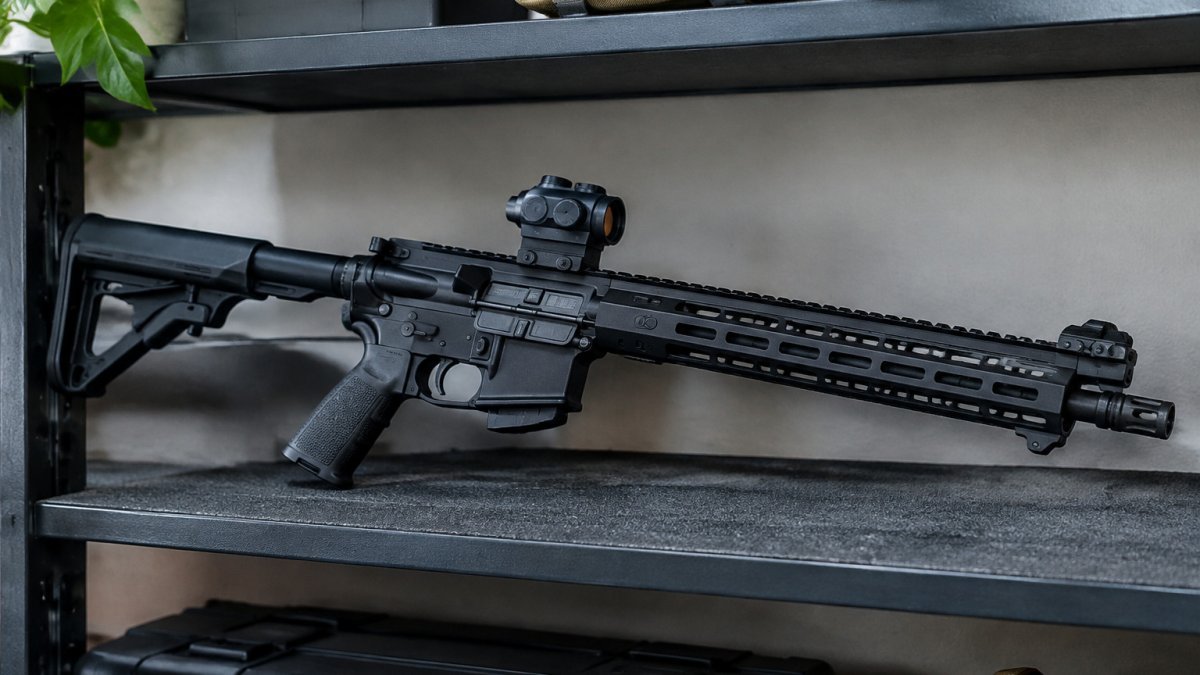
Mounting height matters on a rifle. A lower mount may force you to lift your head off the stock to see the reticle, which hurts consistency. Check that your cheek weld lands at the same spot every time you shoulder the rifle.
Magnified Optics and Close-Range Aiming
Magnification is a trade: it helps you identify and place shots at distance, but it narrows field of view and can slow you down inside a house. The useful question is not whether magnification is good, but which configuration gives you a true 1x for indoor work and optional power for everything else.
Low-power variable optics (LPVOs). A 1-4x, 1-6x, or 1-8x LPVO set to 1x behaves like a wide-field sight with an etched reticle that works even if the battery dies. That etched reticle is a real home-defense advantage: illumination is a bonus, not a requirement. At 1x, keep both eyes open and treat the reticle like a red dot. When you turn the magnification ring up, the image enlarges but so does the wobble in your sight picture, which is why most indoor use stays at 1x.
Prism sights. A prism sight uses a fixed magnification, commonly 1x, 2x, or 3x, with an etched reticle and often a diopter adjustment. The diopter lets you focus the reticle to your eye, which is helpful for shooters with astigmatism who see a projected dot as a smear. A 1x prism is a strong indoor choice; a 2x or 3x prism trades some close-range speed for better target identification.
Magnifiers behind a red dot. A flip-to-side magnifier gives you a 1x red dot most of the time and 3x or 5x on demand. The trade-off is weight, another lens to keep clean, and eye relief that changes when the magnifier swings into place. Confirm the magnifier’s eye relief works with your stock position before you commit.
Eye relief and parallax. Eye relief is the distance range where the full image is visible. Too short and the optic crowds your eye; too long and you see a dark ring or no image. Parallax error is the shift in point of aim when your eye moves off the optic’s centerline; it is smallest at the distance the optic is focused for and grows at other distances. For indoor work, test the optic at the distances you would actually shoot, across a room, down a hallway, not just at 100 yards.
Low-light and identification limits. Magnification does not create light. A magnified optic with a small objective lens gathers less light in a dark room, and a bright illuminated reticle can bloom against a dark target. Ambient light, glare from a window, and the contrast of the target all affect whether you can identify what you are looking at. An optic helps you aim; it does not remove the need to identify your target and what is behind it before you fire.
How to test before you rely on it. Mount the optic, shoulder the firearm in the posture you would use at home, and check that the reticle stays centered and the image stays full through the whole range of magnification. Then repeat in the dimmest room you have. If the reticle washes out or the image darkens, that configuration is not the one for indoor use.
Watch out: a magnified optic that looks crisp at the range in daylight can show a dim, shadowed image in a dark hallway, so evaluate it in the lighting you actually live in.
Battery Life and Durability in Home-Defense Optics
Battery life varies widely. Some red dots run for years on a single cell, while others with brighter settings drain faster. A shake-awake feature turns the optic on when you move the firearm, which can save power, but it also means the optic is not always on. Test it.
Durability depends on construction and recoil resistance. Look for an aluminum housing and ask about warranty coverage for recoil damage before you buy.
Choosing Your Home Defense Optic Setup
Pick the optic that fits your firearm and your priorities. For a pistol, a compact red dot with a sturdy mount usually makes sense. For a rifle, a 1x variable or holographic sight covers most home-defense distances.
Store your firearm safely and keep it unloaded and locked when not in use. Practice with the optic at realistic distances so you learn how it behaves before you need it.
FAFO TACTICAL offers firearms, ammunition and tactical gear, including Class 3 NFA items. Browse the optics section to compare options and find the setup that matches how you plan to use it.
Frequently Asked Questions
What is the best optic for home defense?
For most home defense setups, a low-power red dot sight is the strongest starting point. It offers a wide field of view, fast target acquisition at close range, and a reticle that stays visible with both eyes open. Holographic sights are a comparable option with a larger aiming window, though they typically draw more battery power. Magnified optics are generally unnecessary inside a home, where engagement distances are short. Choose based on the platform, your budget, and how reliably the optic holds zero under recoil. Pricing varies by model and availability, so check FAFO Tactical’s website for current options.
Is a red or green dot better for home defense?
Green dots are generally easier to see against bright and dark backgrounds because the human eye is more sensitive to green wavelengths. That visibility advantage matters in low-light conditions where contrast is limited. Red dots are still widely used and perform well in most indoor lighting. The choice often comes down to the specific optic’s brightness range and battery life rather than color alone. Test the dot in your actual home lighting before relying on it, and confirm the reticle is clear at your preferred brightness setting.
How important is battery life in a home-defense optic?
Battery life matters because a home-defense optic must work when you need it, which may be after long periods of storage. Look for optics with a shake-awake or motion-activated feature, which conserves power when the firearm is not moving. Actual runtime depends on brightness setting and environment. Keep spare batteries on hand and replace them on a regular schedule rather than waiting for the dot to fade. Store the firearm securely and follow all applicable safe storage practices.
Should I use a magnified optic for home defense?
Magnified optics are rarely the best choice for home defense because most engagements occur at close range, where magnification can slow target acquisition and reduce field of view. Low-power variable optics offer a compromise, providing a 1x setting for close work and modest magnification for longer distances. Consider your home layout and typical sight lines when deciding. Practice with any magnified optic at close range to confirm it does not hinder quick, accurate shots.